
Why Curriculum Simplicity Can Be a Strength in Primary Education
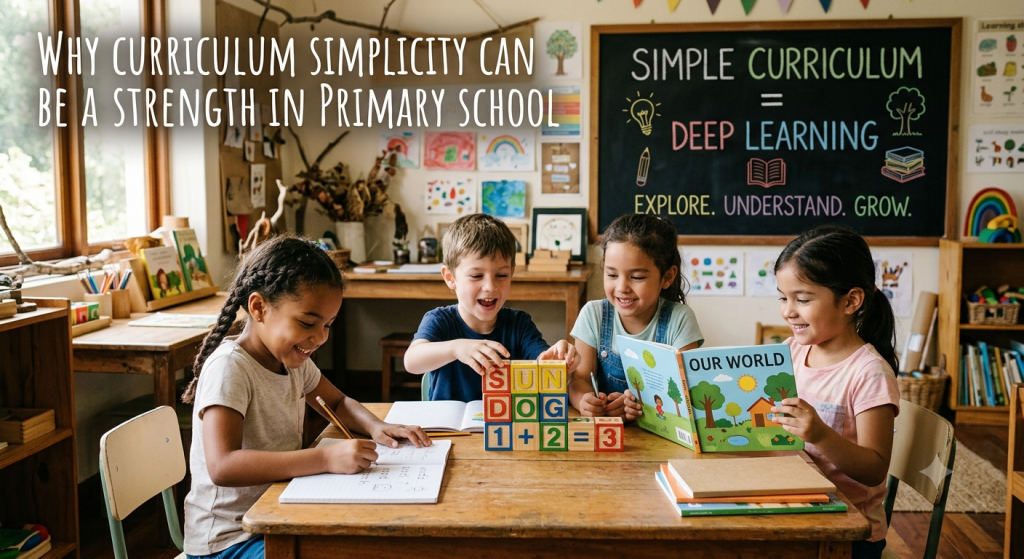
In education, there is often a temptation to believe that more is better: more content, more objectives, more assessment, more resources, more documentation.
Yet some of the most effective curriculums I have encountered throughout my career have not been the most complicated. They have been the clearest.
As schools continue to review and refine their curriculum approaches, I believe there is growing value in recognising that simplicity can be a genuine strength. This does not mean lowering expectations or reducing ambition, in fact, quite the opposite. A strong curriculum requires leaders to make difficult decisions about what matters most and ensure that children have sufficient time to learn it well.
One of the challenges schools face is curriculum overload. Over time, subjects can become crowded with additional content, initiatives and objectives. The result is often a curriculum that feels rushed: teachers feel pressure to cover material, and pupils move quickly from one concept to the next without developing deep understanding.
I have seen this happen particularly when schools focus heavily on coverage. The question becomes, “Have we taught it?” rather than, “Have children learned it?”
The strongest curriculum planning I have experienced has always started with clarity: What do we want children to know? What do we want them to remember? What knowledge, skills and experiences will genuinely make a difference to their lives?
When those priorities are clear, the curriculum becomes easier to sequence, easier to teach and easier for pupils to understand.
Simplicity also supports staff confidence. During my leadership roles, I found that teachers were far more confident when curriculum expectations were clear and coherent. Staff could focus their energy on high-quality teaching rather than trying to navigate endless layers of documentation or competing priorities. This was particularly important when supporting less experienced teachers or subject leaders who were developing their expertise.
If every lesson is packed with content, there is little room for discussion, creativity, investigation or reflection. Some of the most memorable learning experiences I have seen emerged because teachers had time to explore ideas in greater depth. Whether it was children debating environmental issues, building engineering projects, creating stop-motion animations or conducting scientific investigations, these experiences often deepened understanding precisely because pupils were able to engage fully with the learning.
Simplicity can also help children make stronger connections across the curriculum.
When a curriculum is overloaded, subjects can become fragmented and disconnected. By focusing on the most important concepts and knowledge, schools create opportunities for children to revisit ideas, build on prior learning and develop deeper understanding over time.
This becomes particularly important as schools consider future curriculum developments. The challenge is deciding what deserves space, attention and emphasis. In many ways, curriculum design is an exercise in prioritisation.
The best curriculums are not those that attempt to teach everything. They are the ones that identify what matters most, and teach it exceptionally well.
A simple curriculum is not about doing less. It is about creating the clarity, coherence and space children need to learn more deeply, remember more effectively and develop a genuine understanding of the world around them.
Sometimes, less really can be more.